
Research ·
AI Cosmos: An Agentic Infra for Situated Learning
AI that does more than hand you the answer: it helps you learn to do the work, inside a real scenario. We are releasing the AI Cosmos technical report, tested in two preregistered randomized controlled studies.
In 1929, Alfred North Whitehead called the problem of “inert knowledge”—ideas that can be recited but not used—the central problem of all education. Nearly a century later, generative AI makes explanations, worked examples and answers available on demand, and the old problem has returned in a new form.
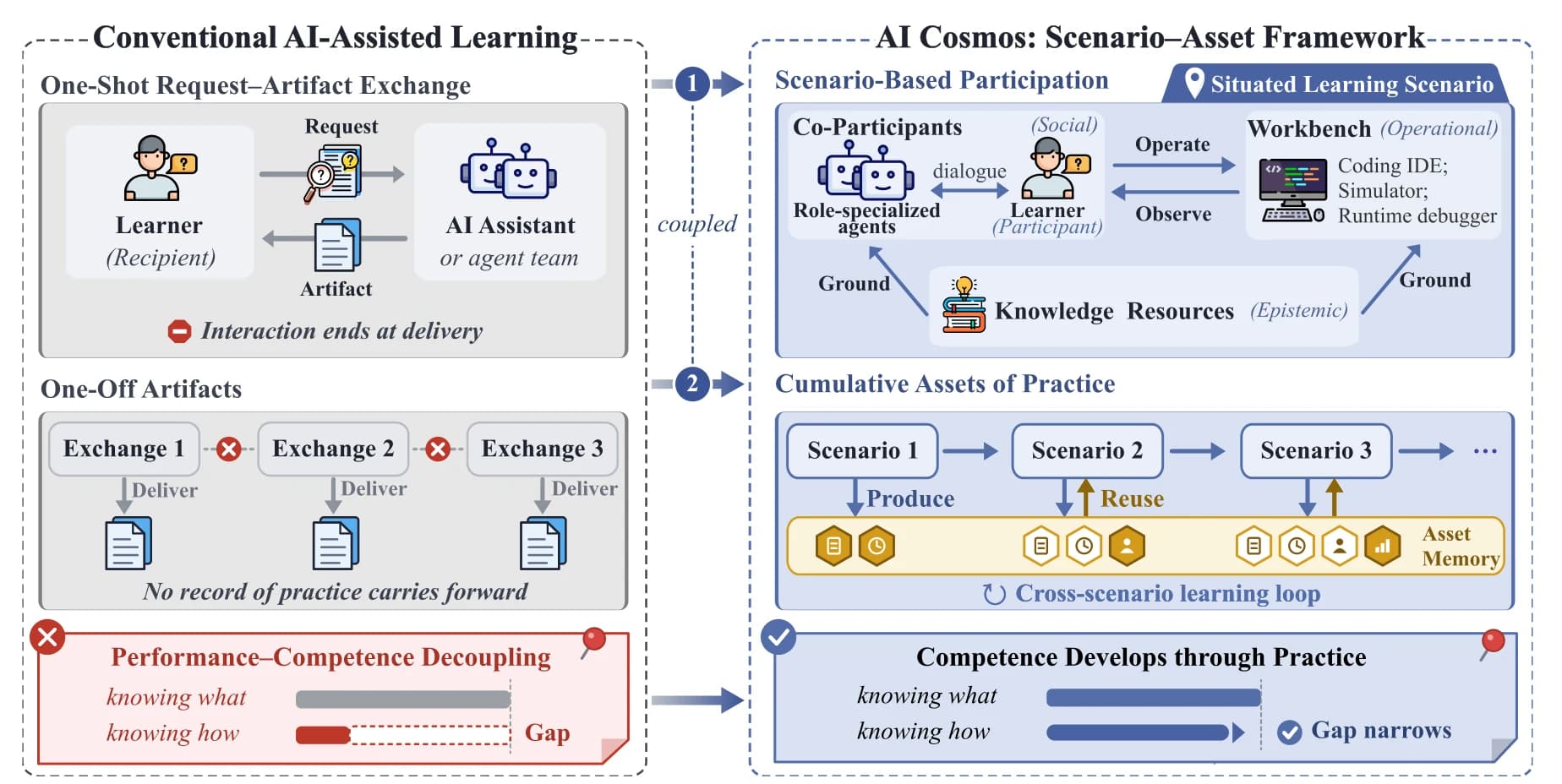
Learners grow fluent at reproducing the concepts and solutions AI provides, without a matching gain in applying them on their own. We call this gap performance–competence decoupling: a student can explain the divide-and-conquer idea behind quicksort yet cannot implement it robustly; a bar candidate can state a doctrine yet cannot apply it to an unfamiliar case.
The cause is not model capability but the interaction scheme. Most AI education tools follow a request–artifact exchange: the learner asks, the system delivers an explanation or a finished product, and the interaction ends. The learner’s own attempts, feedback and revisions happen outside it, and nothing carries forward to the next activity.
Education becomes transformative when knowledge is not merely expressed, but enacted, shared, and turned into reusable intellectual assets.
Manifesto of AI Cosmos
Two shifts: scenarios and assets
AI Cosmos organizes AI-assisted learning around two complementary shifts: from request–artifact exchange to scenario-based participation, and from one-off outputs to cumulative assets of practice.
Scenario-based participation
Every learning activity becomes a scenario: one learning objective, with three dimensions of practice configured around it. Learners and agents coordinate through dialogue, act on shared workbenches when needed, and the results of those operations flow back into the dialogue to guide what happens next.
- SocialRole-specialized agents and learnersAgents take roles such as explainer, mentor or sparring partner and participate alongside the learner; roles decide who is responsible for what.
- EpistemicKnowledge resourcesTask-relevant materials, datasets and prior assets stay queryable throughout the scenario.
- OperationalExecutable workbenchesStateful environments such as a coding IDE or a simulator, where learners and agents create, modify, run and inspect objects.
Cumulative assets of practice
A finished scenario leaves more than a final answer. AI Cosmos keeps the process and outcomes of practice as assets with explicit provenance and dependencies, so later scenarios can retrieve them, compose them and build on them:
- Role specifications
- Reusable participant roles, with responsibilities, behavioral instructions and the conditions they apply to.
- Scenario specifications
- Complete or partial scenario configurations that can be instantiated or adapted.
- Knowledge artifacts
- Objects created or revised in a workbench, such as a slide deck, an annotated document or a code module.
- Process records
- The sequence of actions, feedback, critiques and revisions through which an outcome emerged.
- Experience traces
- Structured evidence distilled from execution: operation outcomes, failure cases, and how configuration choices relate to performance.
System architecture
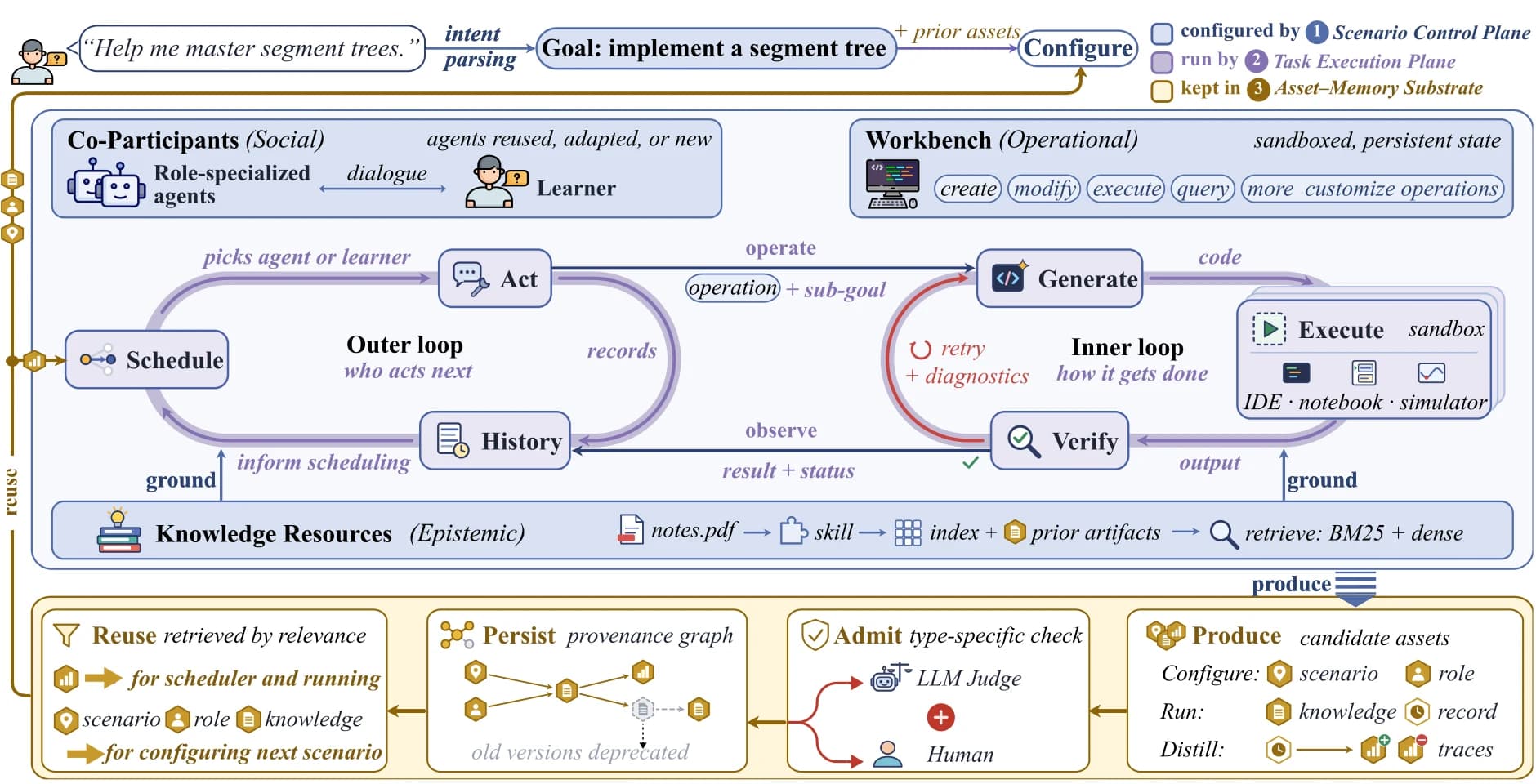
AI Cosmos implements the framework with three interconnected components.
- Scenario control plane
- Parses the learner’s request into an objective, then configures the roles, knowledge base and workbenches that objective needs. Relevant prior assets are reused or adapted; otherwise configurations are synthesized from scratch rather than drawn from a fixed agent team.
- Task execution plane
- An outer loop picks the next participant from the interaction history, moving freely among explanation, questioning, critique, tool use and hand-off to the learner. An inner loop runs operations inside a sandboxed workbench, retrying through generate–execute–verify with diagnostic feedback. Learners can step in at any time and modify the workbench directly.
- Asset–memory substrate
- Produces candidate assets from scenario configurations and records of practice, admits them after type-specific validation (knowledge artifacts also need human approval), and persists them in a provenance graph. Superseded versions are deprecated but kept for rollback, and active assets are retrieved by later scenarios.
Study 1: legal reasoning for bar-exam preparation
Legal problem solving requires more than recalling doctrine: learners must identify the relevant rules in an unfamiliar fact pattern and apply them. We ran a preregistered three-arm randomized controlled trial. 131 students were randomly assigned to a vanilla LLM assistant, the same LLM prompted as an expert tutor (LLM-as-Teacher), or AI Cosmos; after the preregistered data-integrity criteria, the analyzed sample was 111 (37 per arm). All three arms used the same underlying LLM and differed only in interaction architecture.
Scores on a 0–100 scale. The immediate gain over the vanilla LLM is significant (p = 0.018, d = 0.56); the advantage over LLM-as-Teacher and the four-week follow-up differences are not statistically significant.
AI Cosmos learners gained 7.0 percentage points more than the vanilla LLM group (Cohen’s d = 0.56, p = 0.018), and the result held after adjusting for pre-test scores. Giving the same model a teacher persona alone produced no detectable benefit.
The difference lies in how interaction was structured. Total student input was the same across arms (median about 7,100 characters), yet AI Cosmos elicited about 1.7× as many dialogue turns (51.0 versus about 29) with roughly 40% fewer characters per turn—one-shot requests became iterative back-and-forth. The advantage concentrated on scenario-based applied items, pointed the same way for learners with higher and lower prior knowledge, and came with no increase in perceived workload.
Study 2: an executable workbench for competitive programming
The second study focuses on the operational dimension. Competitive programming asks learners not only to understand an algorithm but to implement, run and debug a correct, efficient program. In a preregistered three-arm randomized controlled study stratified into a basic-algorithm and a data-structure track, 54 students completed the full protocol. AI Cosmos added an executable coding workbench to the scenario; both AI Cosmos and LLM-as-Teacher withheld complete solutions, while the vanilla LLM was unconstrained. The post-test used two unseen problems written by two NOI/ACM gold medalists, who also graded all code blind to condition.
G4 means a substantially complete and correct implementation of the target algorithm. Mastery differs significantly from LLM-as-Teacher (p = 0.009); the omnibus difference in post-test scores is not significant (p = 0.20) at this sample size.
On scores alone, AI Cosmos and the vanilla LLM look alike, and both earned partial credit at similar rates (82% and 85%). Inside the code they diverge: 55% of AI Cosmos submissions truly implemented the target algorithm, against 38% for the vanilla LLM, and AI Cosmos had the fewest submissions that collected points without the intended algorithm.
The workbench helped most where learners needed the most scaffolding: in the basic-algorithm track, AI Cosmos beat LLM-as-Teacher by 31.4 post-test points. And only under AI Cosmos did performance track learners’ prior ability (r = 0.59, p = 0.008); in both control arms the correlation was near zero. When learners can lean on generated code, scores partly measure the assistant. Requiring learners to construct, run and repair their own programs makes the score a faithful measure of the person again.
Conclusion
Both studies point to the same lesson: effective AI learning systems must align interaction structure with the form of the target competence. Structured dialogue serves domains where reasoning itself is the object of practice; executable workbenches serve domains where competence emerges through construction, testing and revision. AI Cosmos couples guidance with the artifacts learners practice on, and turns every round of practice into a starting point for the next.